
A thick, shallow right-hander in the Hinako Islands off Nias, Bawa is one of Sumatra's heaviest waves and strictly for experienced surfers.
Also known as Pulau Bawa.
Bawa breaks off Pulau Bawa in the Hinako Islands, a small scatter of land off the west coast of Nias in North Sumatra. Worth saying plainly up front: this is not a Mentawai wave and it does not sit inside the Telos. It is well north of both, on its own, with nothing between it and the open Indian Ocean. Bawa picks up more swell than almost anything near it and is usually a size bigger than everywhere around.
It came to the world's attention in 1994, when Tom Curren and Frankie Oberholzer surfed it on a Rip Curl Search trip, Curren famously riding a 5ft 7in fish. What people saw was a thick, ledging right-hander of a size Indonesia was not known for at the time, and Bawa has carried a reputation as one of the heaviest waves in Sumatra ever since. The 2005 Nias earthquake lifted reefs along this stretch of coast, some of them by a couple of metres, and rearranged the shelf under the wave. Surfers who knew it before say it lost some of its old end section, but on the right swell it still throws the barrel that made its name.
The wave
Bawa runs out of deep water onto a shallow shelf of hard, dead coral. There is very little transition, so the swell stands up fast and the take-off carries real consequence. The peak is shifty, more so since the reef moved in 2005, and people who have spent time there talk about sitting deep, guessing, and copping late drops for their trouble. Miss one and you are in open water with nothing to sit on.
Around head high it is a broader, friendlier thing: shifty peaks, wally runners, the odd quick tube off the take-off. From about four to five feet it starts to tube in earnest, and at six feet and up it changes character altogether. A big open face runs into an inside section that bowls hard over the shallowest coral and throws thick, fast barrels. That inside bowl is the part people travel for, and it is also the part that hurts them.
Tide matters here more than most places. Mid to high gives you a buffer over the reef; low turns an already shallow wave into something genuinely dangerous. Wind is the other lever. Bawa comes good when the breeze has some north in it, often the same wind that ruins Asu across the way, so the two work as a pair. The main season runs April to October, and the bigger it gets the better it gets. Bawa holds size that shuts most reefs down.
Conditions at a glance
- Wave type: Right-hand reef break
- Best swell: South to south-west groundswell out of deep water. Bawa is a swell magnet and will usually be bigger than the breaks around it.
- Best wind: Light offshore with north in it, anywhere from north-west through north-east. Guides differ on the exact bearing, but they agree Bawa wants what Asu does not, so the two swap days.
- Best tide: Mid to high, which gives you a buffer over the reef. Low tide is shallow and unforgiving.
- Best size: Rideable from head high, and it starts to tube properly around four to five feet. Most guides put the sweet spot at six to eight feet, and it holds well past that without shutting down.
- Season: April to October, the main dry-season swell window for this stretch of Sumatra. Swell reaches it outside those months too.
- Crowd: Rarely crowded. It is remote and boat access only, and most traffic in the Hinakos heads for Asu instead, so you are usually sharing with a handful. On a standout swell a few boats can arrive at once.
- Where: Pulau Bawa, Hinako Islands, Nias
Who it suits
This is an advanced to expert wave and there is no point softening it. The reef is sharp, shallow and hard, the lip carries real weight, and hold-downs are long. Broken boards, reef cuts and worse are part of the history of the place. Bawa is also remote: there is no clinic on the island and proper medical help is hours away at best, so a bad injury here is a far bigger problem than the same injury somewhere with a road.
If you surf solid reef passes confidently, take late drops without thinking about them, and have a step-up you trust, Bawa is worth the trip. If you are still working up to overhead reef, this is the wrong place to do it, and on a proper swell it is simply not a wave for you. There is no easy shoulder to slide into and no small corner to practise on. A strong intermediate might get something from a smaller, clean day on the right tide, but that is a different wave to the one Bawa is known for.
How to surf Bawa with WaveBorn
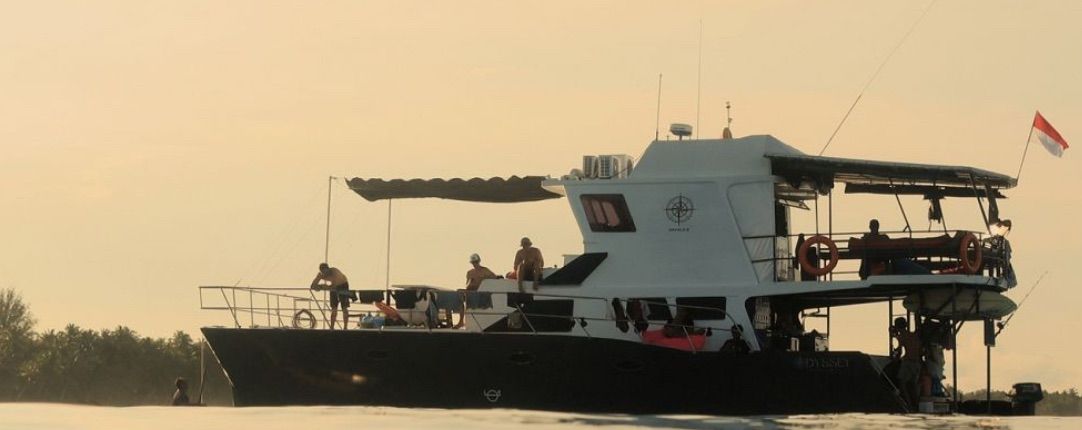
Bawa has no camp on it and no walk-in, so a boat is the only realistic way to surf it. Both of our charters run the northern route up to the Hinakos: Ombak Kabau with up to ten guests, and Odyssey Mentawai, our 46ft catamaran, with up to eight and a surf pro aboard. It is a long way north of the usual Mentawai loop, so a Bawa trip is planned around the swell rather than slotted into any week. Say it is the wave you are coming for when you enquire and we will build the route around it.
The advantage of chasing a wave like this from a boat is patience. Bawa wants a particular mix of swell, north-leaning wind and mid to high tide, and from the deck you can wait for that window instead of burning your one shot. If the wind swings onshore or the swell drops away, you move and surf something else. With a skipper who knows these waters and a crew helping you read where the peak has shifted to, you get a fair crack at it without a crowd of your own making.
Trips that reach it: Ombak Kabau and Odyssey Mentawai .
Nearby breaks
Bawa sits within easy reach of Asu, Mini Bawa, Sirombu and Lagundri Bay (Sorake) , which is what makes this part of the archipelago so productive: if the wind or swell does not suit one reef, another is usually working a short ride away.
Conditions here are a guide, not a guarantee. Our crew reads the swell, wind and tide each morning and puts you on the break that matches your surfing that day. See the full Mentawai surf spots guide or browse every break we surf.