
A hollow, mechanical left in the northern Playgrounds, often called the Mentawai answer to Teahupoo in miniature.
Kandui is one of the standout lefts of the northern Mentawais and a fixture of any charter trip that pushes into the Playgrounds region. It is a heavy, hollow wave that draws water off a shallow reef and delivers barrels with far more consequence than its modest size suggests.
It sits within a tight cluster of quality waves, which is a large part of the appeal: if Kandui is too heavy for your group on a given day, several friendlier options are minutes away.
The wave
The wave jacks quickly on the reef and offers a steep, committing take-off straight into the barrel. It is short and intense rather than long and running, which makes it a barrel hunter's wave rather than a carving wave.
It is best on a mid to high tide, when there is enough water over the reef to make the inside section survivable. On a lower tide it becomes genuinely dangerous and is better admired from the boat.
Because it is a left in a region full of famous rights, it is often the wave that saves a trip when the wind direction rules the right-handers out.
Conditions at a glance
- Wave type: Left-hand reef break
- Best swell: SW to S groundswell
- Best wind: NE to E offshore
- Best tide: Mid to high
- Best size: 3ft to 8ft
- Season: April to October
- Crowd: Moderate to busy, with a resort nearby. Dawn sessions are the move.
- Where: Karangmajat, North Mentawai
History and reputation
Kandui breaks off the northern tip of Pulau Karangmajat, which is why you will also see it written as Karangmajat Left. The wider discovery story belongs to Martin Daly and the Indies Trader. Daly had been working this coast since the 1980s and kept it quiet for close to a decade, until photographs from a 1992 trip carrying Ross Clarke-Jones, Tom Carroll and Martin Potter reached the magazines and the region stopped being a secret. That trip is documented as a Mentawai-wide moment. No account we can find puts those surfers on this particular wave, so read 1992 as the year the region opened up rather than the year Kandui was first ridden.
The name is unsettled, and the stories behind it do not agree with each other. The popular version is that it was called No Kandui because the wave was so fast and so hollow that making it was the exception. A competing account has it as a play on words: pocket guides from the mid 2000s listed the right as Kandui, so the left became No Kandui. A third version says the name came off a magazine trip and the surf press did the rest. Nobody has attached a first-hand source or a date to any of them, so treat all three as line-up lore. What has settled is usage. The No has quietly fallen off, and most people now just say Kandui or Kandui Left. The reputation is the part nobody argues about. It is regularly named among the heaviest lefts in Indonesia, and it earned that on tube time rather than turns.
What has really changed is access. For years this was a boat wave, surfed by whoever happened to be anchored nearby. Kandui Resort says it began building in 2004 and opened in 2006, and Kandui Villas followed in 2007, set up by the same founders. Those dates come from the operators rather than any independent record. The two are different places and are easy to mix up when you are booking: Kandui Villas sits in front of this wave, while Kandui Resort looks out at 4 Bobs. Either way, the wave went from an occasional charter stop to one with beds close by, and ten to thirty surfers in season is now normal. The exception was 2020. When Indonesia closed its borders that March, a couple of people already at Kandui Resort stayed on, among them the Costa Rican professional Anthony Fillingim, and they had these waves close to themselves for four or five months. It made the surf press precisely because an empty Kandui does not happen.
Who it suits
Advanced surfers with barrel experience and a healthy respect for shallow reef. Confident intermediates can get good waves here on a smaller, higher-tide day with a guide reading the sets.
It is not a wave for anyone still learning to handle steep take-offs. The nearby Playgrounds breaks are the better call.
Surfing Kandui well
Bring more board than you think
A standard shortboard is the wrong tool here. The wave rewards paddle speed and a rail line you can hold high on a wall that keeps running, which points at a step-up: a few inches longer than your everyday board, pulled in through the tail towards a rounded pin, a touch thicker and glassed heavier. Something in the 6'2" to 6'6" range suits a lot of people, but take that as a starting point for a conversation with your shaper rather than a spec sheet. The counterintuitive part is that Kandui often gets more makeable as it gets bigger, because the wall lines up instead of shutting down. That only holds if you have the board under you to match it.
Come in from the channel, sit deep
There is a channel running beside the take-off at the top of the reef, and it is both your way out and your way back. Paddle around through it rather than picking a line across the shallows. Once you are out, sit closer to the peak than feels comfortable. Deep here means up by the channel end, which is also the deepest water in the line-up, so it is the safer place to sit as well as the only place the wave is really makeable. Sit wide and you get a fast closed wall and a long swim. Rides can run a few hundred metres down the reef, so when you come off, get wide into the channel and paddle back up through deep water instead of crossing the inside.
Read the reef, not the tide table
The wave wants fuller water and it wants at least head high to be worth it. Below that it loses its shape while the reef stays exactly as close. The better habit is reading the reef itself. On low water the inside dries out and shows you which sections will hurt you, so sit in the boat and watch it through a low tide once before you ever paddle out. A pushing tide is usually kinder than a draining one, because the end section holds more water just where you are coming out of it.
Read the pack, know your exit
The line-up mixes guests who have been surfing it all week with charter crews dropped straight onto the peak, and it turns over fast. Sit through a few sets and work out who is deep before you go. The most common visitor mistake is trying to perform: chasing turns on the open face, burning energy, then getting caught inside where it is shallowest. The second is staying out when the wave has outgrown you. Baby Kandui is about five minutes' paddle down the reef and it is a genuinely good wave in its own right, so there is no shame in going there. Reef cuts out here mean a long boat ride back towards Padang before anyone can properly look at you, which is the real reason to surf within yourself.
How to surf Kandui with WaveBorn
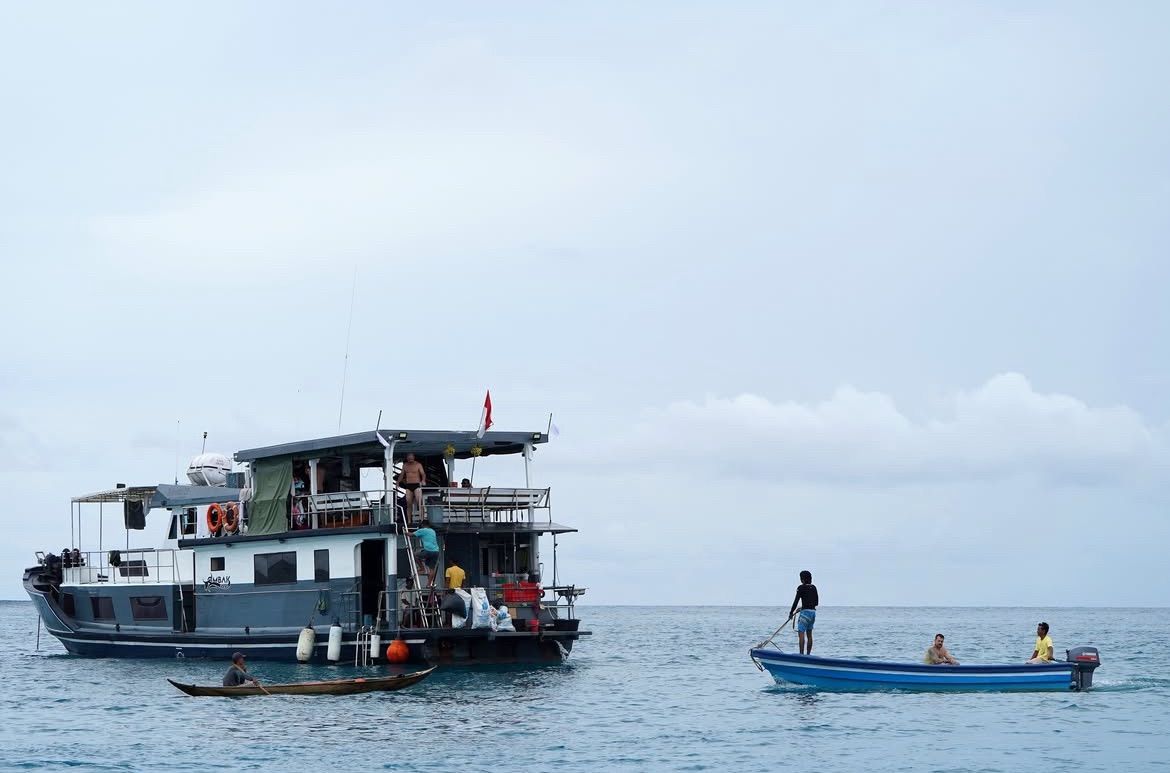
Kandui is deep in the northern Mentawais, best reached by boat. Its position within the Playgrounds cluster means a charter can park nearby and let the group split across several breaks according to ability.
Our charters run the full chain and head north when the forecast favours it, so the experienced surfers can chase Kandui and Rifles while everyone else surfs the softer waves nearby on the same tide.
Trips that reach it: Ombak Kabau and Odyssey Mentawai .
Nearby breaks
Kandui sits within easy reach of Rifles, Bank Vaults and No Kandui , which is what makes this part of the archipelago so productive: if the wind or swell does not suit one reef, another is usually working a short ride away.
More breaks in North Mentawai
- E-Bay : A fickle, world-class left in the Playgrounds that barrels from start to finish when the swell has enough west in it.
- Burgerworld : A long, playful right-hand reef point in the Playgrounds that switches on when the heavier North Mentawai reefs go flat.
- Nipussi : A consistent right-hand reef in the Playgrounds that stays clean on north winds and needs less swell than its heavier neighbours.
- Hideaways : A world-class Playgrounds left that opens with a hollow ledge and runs into a long rippable wall, over reef that punishes greed.
Conditions here are a guide, not a guarantee. Our crew reads the swell, wind and tide each morning and puts you on the break that matches your surfing that day. See the full Mentawai surf spots guide or browse every break we surf.