
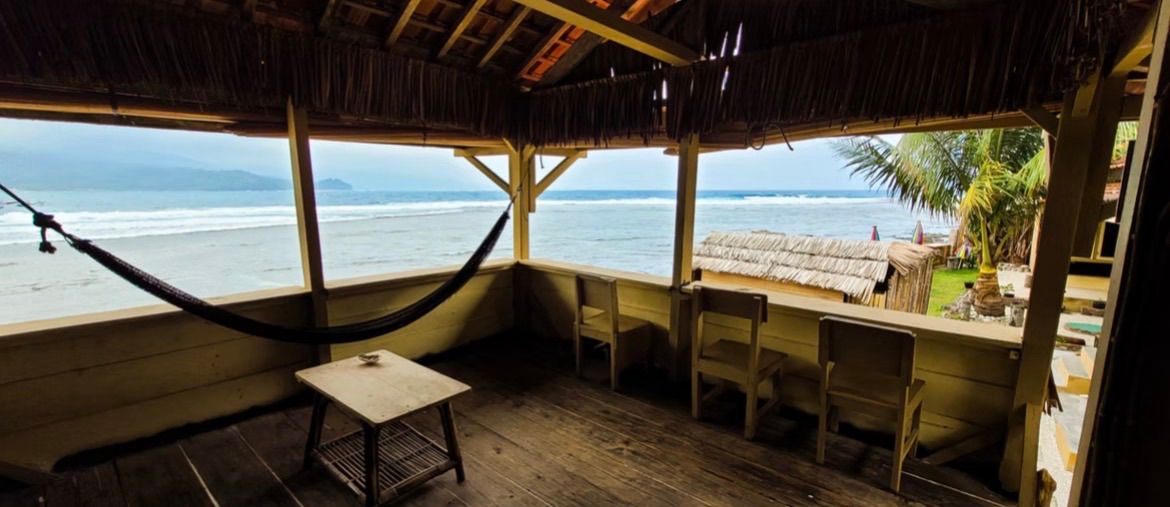
A long run of black sand south of Krui that catches every south swell, throwing thick shifting barrels for anyone willing to walk and start early.
Also known as Mandiri.
Mandiri is the beach break that keeps the Krui coast honest. Roughly seven kilometres of black sand running south of town, open to every south and south-west swell that tracks up the Indian Ocean, and almost never flat. When the reefs down the road are too big, too fickle or too crowded, Mandiri is where people end up.
It has a reputation as one of the best beach breaks in Indonesia, and on the right morning that holds up. It is also honest about what it is: sand, wind and timing. The banks move, the peaks wander, and the whole thing usually falls apart by mid morning. Get it right and you get thick, hollow waves with almost nobody on them. Get it wrong and you get a workout.
The wave
About a kilometre offshore there is a strip of reef that trips the incoming swell before it ever reaches the sand. The swell arrives on the beach already broken up, reorganised into triangular peaks that stand up and detonate more or less at random along the strand. That filtering is what gives Mandiri its shape. Deep water straight into shallow sand, then a wave that stands up fast and squares off.
Both directions go. On a clean, well-defined bank you get short, thick barrels over water that can be thigh deep, then a wall that runs long enough to make something of. Waist high in the quiet months, overhead to double overhead through the dry season. Around head high to half again overhead is where it works best. Any bigger and the peaks start closing out and the sweep takes charge.
Nothing here is permanent. The banks are pounded by constant swell and onshore wind, so a peak that was perfect yesterday can be a closeout today. That means walking. The busiest waves sit at the southern end near the warungs, and the emptier ones are usually further north towards Lintik, though that end has more of a reputation for theft. Winds drain north-east to east off the mountains at dawn and turn onto the beach by mid morning, so the surf here is an early start.
Conditions at a glance
- Wave type: Exposed black sand beach break, shifting sandbank peaks filtered by an outer reef about a kilometre offshore
- Best swell: South to south-west groundswell. It does not need much: this stretch is a genuine swell magnet that picks up almost anything in the water and rarely goes flat, which is why it stays surfable when the reefs go quiet.
- Best wind: North-east to east offshore, which in practice means dawn. The mountain air drains offshore overnight, then the wind swings onto the beach somewhere between ten and eleven most mornings and the whole place turns to mush.
- Best tide: All tides produce waves. Big swell on a running outgoing tide is the one to avoid, the sweep and the offshore drag get serious.
- Best size: Waist high to double overhead. Head high to about half again overhead is the sweet spot, before the peaks start closing out.
- Season: May to October carries the size, but it is also the windiest stretch of the year, so it is often a dawn-only affair. The shoulder months, roughly February to April and late October into November, are usually the pick for the beach break itself.
- Crowd: Moderate and easy to escape. Expect around ten surfers on a busy peak, most of them on the southern end near the warungs, and often nobody at all on the banks further north. Localism is close to nil.
- Where: Krui coast, Pesisir Barat, Krui, South Sumatra
Who it suits
On a small, clean morning Mandiri is as friendly as a fast beach break gets. Chest high peaks over sand, plenty of room to spread out and a relaxed lineup with almost no localism. That is confident intermediate territory and most guides rate the wave intermediate to advanced overall. Improvers who can already read a rip and handle moving water will find waves on the smaller inside banks at the southern end, but this is not a learners' beach and it should not be treated as one.
When it is big it becomes a different wave entirely. The rips are strong and will drag you hundreds of metres down the beach or straight out to sea, and a big swell on a run-out tide is genuinely dangerous. Hold-downs pin people to the sand, the lip lands hard and boards break. There are no lifeguards and no surf rescue on this coast, so do not paddle out alone.
How to surf Mandiri Beach with WaveBorn
Jenny's Bamboo Surfcamp is our base on this coast, up at Kuripan in Pesisir Utara. The camp sits right on Jenny's Right with four waves out front, and roughly a dozen named breaks sit within reach of a scooter. Mandiri is on that list, though it is at the far end of the range: a run south past Krui town, an hour or so each way rather than a quick hop. Scooters are rented on site.
That distance shapes how you surf it. Because Mandiri is a dawn wave, the move is to leave the camp in the dark, or to make a day of it and pair Mandiri with the reefs further south, Ujung Bocur sitting at the southern end of the same beach. Our guides watch the swell and the wind and will tell you plainly when it is worth the ride and when the waves out front are the better call.
Trips that reach it: Jenny's Bamboo Surfcamp .
Nearby breaks
Mandiri Beach sits within easy reach of Ujung Bocur, Way Jambu, Krui Left and Jenny's Right , which is what makes this part of the archipelago so productive: if the wind or swell does not suit one reef, another is usually working a short ride away.
Conditions here are a guide, not a guarantee. Our crew reads the swell, wind and tide each morning and puts you on the break that matches your surfing that day. See the full Mentawai surf spots guide or browse every break we surf.