
A long, versatile left off Sipora that works across a huge range of sizes, and a favourite of ours.
Also known as Teles.
Telescopes is one of the most useful waves in the central Mentawais. It is a long left that runs down a reef point on Sipora, and its great virtue is range: it is enjoyable at two feet and genuinely serious at eight.
That versatility makes it a cornerstone wave for mixed-ability groups, and it is one of the few marquee breaks reachable from both our charters and our land-based villas.
The wave
The wave starts with a peaky take-off and then walls up into a long, workable face. On a small to medium swell it is a rippable playground with plenty of room for turns. As the size increases the inside section gets hollow and fast, and the whole wave takes on real power.
It handles wind well from the east and south-east, and it picks up more swell than some of the neighbouring breaks, which means it is often working when quieter options have gone flat.
Rides here are long by any standard, and because the wave has several distinct sections you can find your own space rather than fighting for one peak.
Conditions at a glance
- Wave type: Left-hand reef break
- Best swell: S to SW groundswell
- Best wind: E to SE offshore
- Best tide: Mid
- Best size: 2ft to 8ft
- Season: April to October, with surf most of the year
- Crowd: Moderate. Popular but long enough to spread people out.
- Where: Sipora, Central Mentawai
History and reputation
Telescopes had a name before most surfers knew where it was. In 1990 Dan Madre, a Jakarta based geologist and a friend of Martin Daly's, went exploring the Mentawais with his brother Martin and a mate, Dave Schiller. They ran a zodiac between the islands and slept on beaches, and Madre came home with video of waves he had named himself. Telescopes was one of them. By Indies Trader's own telling the naming right belonged to whoever first rode a wave start to finish, and the names worked as code that gave away nothing about where the place was. Why he settled on Telescopes has never been written down anywhere we can find, so treat any explanation you hear on a boat as a story rather than a fact.
North Sipora is also where the charter story got going, for an unglamorous reason. The fullest account of it puts Daly's first Mentawai voyage on the Indies Trader in 1991, and it was salvage work, lifting a sunken crane off Tuapejat at the north end of the island with a barge and a heavy winch. Tellings vary by about a year. With the salvage done, the boat went looking for waves. In 1992 the Indies Trader carried Tom Carroll, Ross Clarke-Jones and Martin Potter through the region, photos from that trip reached the magazines, and the Mentawais stopped being a rumour. Whether anyone stopped at Telescopes on that trip is not recorded.
Its reputation has always sat a little apart from its famous neighbours. Telescopes is fussier than most and wants a solid west or south west swell before it shows what it can do, which is why it can sit quiet while other spots are working. It has a sleeper reputation for that reason, ordinary more often than it is exceptional, then worth every bit of the wait when it lines up. Access has changed more than the wave has. Dozens of charter boats now run out of Padang, and Tuapejat has become the regency capital with a fast ferry from the mainland three or four days a week. Boat crews and land based surfers can turn up on the same morning.
Who it suits
Almost everyone, which is the point. Improving surfers get a manageable wall on the smaller days. Advanced surfers get a fast, hollow inside when it is bigger. It is one of the best waves in the region for a group with mixed ability.
If your crew ranges from confident intermediate to expert, Telescopes is the wave most likely to keep everyone happy on the same session.
Surfing Telescopes well
Bring a board with some paddle in it
Telescopes is a long wave. Two hundred metres is a normal good ride here, so what usually ends a session early is your arms, not a wipeout. A board with a bit of paddle and glide beats your smallest chip. Most people are happiest on their usual shortboard with a little extra volume at head high, and you want a genuine step up once a real west or south west swell arrives, because the drop gets steep and the wall keeps moving away from you. Bring a spare too. Boats and camps carry repair kits, but you are still a long way from a shaper.
Watch the sets, then mind the inside bend
The take off is steep and fairly defined, so sit and watch a few sets before you jump in rather than paddling straight into the middle of it. From there the wave walls up and runs. The bend on the inside, which boat crews and camps call Monkey's Corner, hooks back at you and can hand you a second barrel if you made it through the first section. Do not be surprised if a skipper calls it something else, it is crew shorthand rather than a name on any chart. The current runs along the reef and strengthens as the swell builds, so pick a landmark ashore and check it often instead of noticing the drift twenty minutes too late.
Let the tide make the call
Mid tide is the standard answer here, and it is worth building the day around rather than surfing whenever the boat happens to be sitting there. Down near the bottom of the tide the inside gets genuinely shallow and the quick sections stop being forgiving, which is the wrong place to find your limits this far from a hospital. Opinions split on the top of the tide, some rate it and some reckon the wave goes soft, so ask your skipper what it has been doing that week rather than trusting a printed table. Wind counts as much as tide. Look at it at first light and be ready to move if it swings.
Read what has arrived, not just the wave
Numbers here depend on what has turned up, the boats anchored off and now the land camps along this stretch of coast as well. A quiet line up becomes thirty surfers when two charters pull in together and everyone paddles out at once. Let that settle rather than joining the scramble, take the waves nobody else is on, and do not park on the peak for a whole session. The mistake people make is treating Telescopes as the easy Mentawai wave. The shelf under the main part of the break is deeper than a lot of reefs out here, which is exactly why surfers get casual on it, and the inside is still sharp coral hours from any real medical help.
How to surf Telescopes with WaveBorn
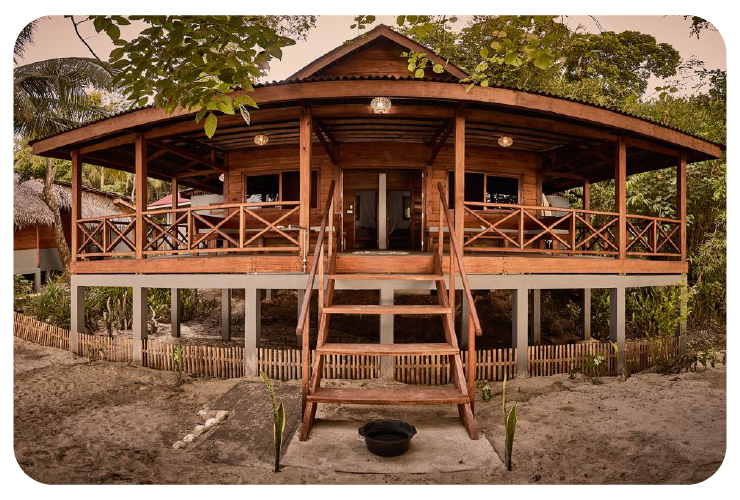
Telescopes is unusual in being reachable two ways with us. Our charters surf it as part of a central Mentawai run, and it is also within the daily range of Sunset Surf Villas, whose private boat puts you in the line-up in well under half an hour.
That makes it the ideal wave if you are undecided between a boat trip and a land-based stay: you can surf it either way, so choose the style of trip you want rather than compromising on waves.
Trips that reach it: Ombak Kabau , Odyssey Mentawai and Sunset Surf Villas .
Nearby breaks
Telescopes sits within easy reach of Icelands, Suicides, Scarecrows and Tikus , which is what makes this part of the archipelago so productive: if the wind or swell does not suit one reef, another is usually working a short ride away.
More breaks in Central Mentawai
- Lance's Right : A perfect, photogenic right-hand barrel and probably the most photographed wave in Indonesia.
- Lance's Left : A long, consistent left that wraps down the reef at Katiet in three sections, from a shallow barrel up top to rippable walls on the inside.
- Ombak Tidur : A sectiony right-hand reef off North Sipora that picks up swell on the smaller days and rarely carries a crowd.
- Doughnuts : A fickle, expert-only left off North Sipora that barrels hard over shallow coral on the rare days it switches on.
- Bintangs : A short, dredging right across the channel from Lance's Left that turns on when the north wind ruins everything else in the bay.
Conditions here are a guide, not a guarantee. Our crew reads the swell, wind and tide each morning and puts you on the break that matches your surfing that day. See the full Mentawai surf spots guide or browse every break we surf.