
A heavy, shifting left off the Pagais that keeps breaking when most of the chain has gone flat or too big.
Also known as Thunders Left.
Thunders sits at the southern end of the Mentawai chain, off the Pagai islands, and the name is not marketing. This is a heavy, bowly left that breaks hard enough to hear from the boat, throwing up so much whitewater that it often has not cleared before the next set arrives. It is a swell magnet and one of the most reliable waves in the archipelago, holding size long after the more delicate reefs up the chain have stopped making sense.
Among charter skippers it has a particular standing. Thunders is where you point the boat when a big south swell fills in and half the chain is closed out or unruly. Few surfers fall in love with it on first look, because the lineup shifts and the current works against you from the moment you paddle out, but the people who put in the time here talk about it with real respect.
The wave
Thunders breaks left over live coral, and it does not break in one single place. Several take-off zones spread along the reef, which is part of why it seldom feels as busy as a wave of this quality should. The trade-off is a lineup that shifts. Sets swing wide, then correct, and twenty minutes in the wrong spot is a normal part of a session here. Watch where the sets are actually landing rather than where they landed last time, and expect to keep moving.
Tide changes the wave's character more than it changes whether it works, because Thunders is surfable right across the tide. On the fuller tide it runs closer to the island and stands up over a shallow inside shelf, and that is where the fast tube sections appear. Drop the tide and the peak shifts further out the back, offering a thicker, more forceful shoulder with more room to set a line.
Size is where Thunders separates itself from its neighbours. It will break at chest high, but the reputation is built at the top of the range, where it keeps its shape at sizes that shut most of the chain down. On a moderate south swell you get speed barrel sections running up the reef. Push it into the double and triple overhead bracket and the sets swing wide and unload down the reef, funnelling whitewater onto anyone caught inside, and the current becomes the main problem you spend the session solving.
Conditions at a glance
- Wave type: Left-hand coral reef break
- Best swell: South to south-west groundswell
- Best wind: East to south-east offshore. It handles the trade winds better than several of the more exposed peaks nearby, which is part of why it stays surfable when they do not.
- Best tide: All tides. Fuller tide brings the fast inside tube sections, lower tide moves the peak further out the back for a thicker shoulder
- Best size: Chest high on the small days through to well overhead and beyond, roughly 3 to 12ft. It earns its name once it gets properly big.
- Season: April to October, within a wider trade wind season of roughly March to November
- Crowd: Rarely crowded by Mentawai standards, partly because several take-off zones spread people along the reef and partly because almost everyone arrives by charter boat. Expect a handful of surfers most days, and up to around twenty when the rest of the chain has gone flat or unruly and the boats all point this way. No real localism.
- Where: South Pagai, South Mentawai
Who it suits
Be honest with yourself about this one. Thunders is an advanced wave. The take-off is bowly and shifting, the bottom is live coral, and the current is strong enough that a good share of any session is paddling rather than surfing. It is a poor choice for a surfer still building confidence in overhead reef waves, and not the place to have your first coral wipeout. On a smaller, cleaner day a solid intermediate with real reef experience can enjoy the shoulder. On a proper swell, that same surfer becomes a passenger.
If you are going to surf it, come equipped. Bring more board than you think you need, because the extra paddle speed is what makes the current manageable and gets you onto the shifting peaks. A helmet and reef boots are sensible here rather than fussy. Watch a few sets before you jump in, work out where the deeper water sits, and accept that your first session is mostly about learning the lineup.
How to surf Thunders with WaveBorn
Thunders is a boat wave. Access is by boat, and both of the WaveBorn trips that reach it are charters. Our land-based options sit elsewhere: Sunset Surf Villas is in the central Mentawai and Jenny's Bamboo Surfcamp is over at Krui in South Sumatra, so neither one puts you within reach of this end of the chain. Ombak Kabau is our live-aboard charter, up to ten guests, eleven nights on board and ten surf days, and she roams the entire Mentawai chain rather than working a fixed loop. That matters here, because Thunders is at its best on the bigger southerly swells, and a boat that can run south when the forecast asks for it is the difference between surfing the wave and watching it from the deck.
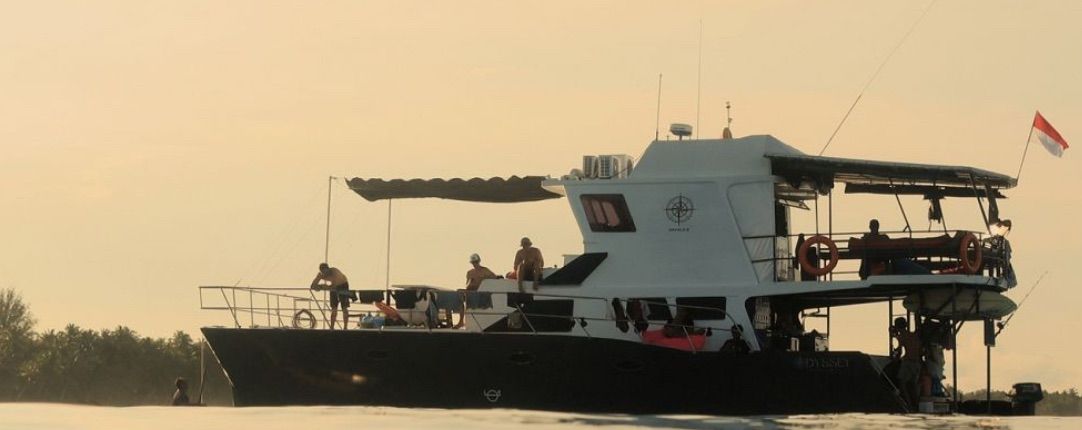
Odyssey Mentawai is our 46ft catamaran, up to eight guests, with a surf pro on board. She covers the Mentawai and also runs to the quieter Tello Islands, so the itinerary follows where the swell is landing rather than a set route. A guide who has surfed Thunders before is worth a great deal at a wave with this many take-off zones, especially for working out which peak to sit on. On both boats, surfing Thunders is a forecast call made a day or two out, not a fixed stop on a schedule.
Trips that reach it: Ombak Kabau and Odyssey Mentawai .
Nearby breaks
Thunders sits within easy reach of Thunderbox, Roxies, Greenbush and Macaronis , which is what makes this part of the archipelago so productive: if the wind or swell does not suit one reef, another is usually working a short ride away.
Conditions here are a guide, not a guarantee. Our crew reads the swell, wind and tide each morning and puts you on the break that matches your surfing that day. See the full Mentawai surf spots guide or browse every break we surf.